
EXG Expanded Gamut Printing, is it worth it?
The Promises, the Pitfalls, and the Solutions to Expanded Gamut Printing
EXG, ECG, Multicolor—whatever the acronym, they all refer to the same thing: printing with more than the standard four process colors (CMYK) to expand the color gamut and simulate spot colors more efficiently.
The concept isn’t new. Expanded gamut printing (EXG) has existed since the 1990s to overcome the limitations of CMYK in rendering certain hues, contrast ranges, and brand colors. You’re likely using some form of it already—your digital proofer, photo printer, or even an inkjet might be running additional inks like light cyan, light magenta, green, orange, or red. These help achieve smooth gradients and vibrant color reproduction in photographic and proofing contexts.
But translating this concept from digital devices to industrial offset or flexo printing introduces a completely different set of challenges.
Why Consider Expanded Gamut in Industrial Print Production?
When done right, EXG offers clear and measurable benefits:
- Reduced planning effort: A fixed ink set can simulate many* spot colors without requiring job-specific ink mixing or inventory management.
- Fewer press units per job: Instead of dedicating separate units to each spot color, a 5- to 7-color ink set can simulate multiple spots across jobs.
- Simplified press setup: Reduced cleaning time, less ink washup’s lead to faster job turnaround.
- Leaner workflows: EXG allows for a standardized production environment with less variability between jobs.
- Potential cost and time savings: Once integrated, EXG can reduce waste, speed up delivery, and scale more efficiently—especially for short- to medium-run jobs with complex spot color needs.
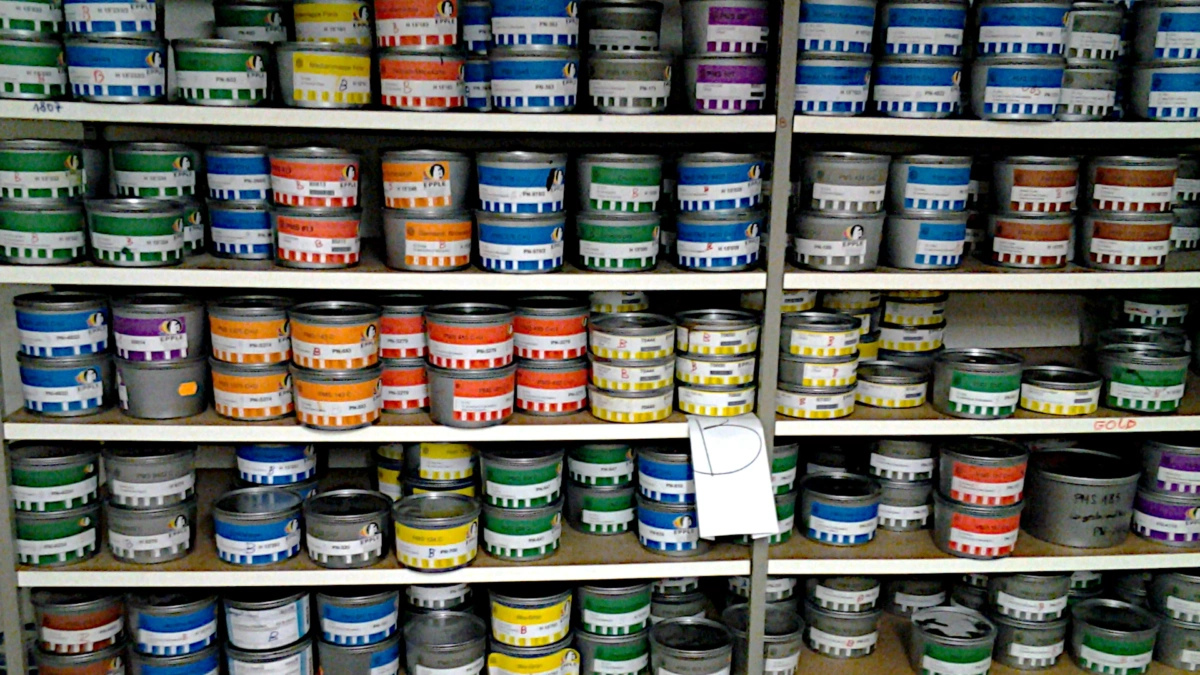
Spot colors are expensive, require planning, handling, and storage. Print service providers want to lower the efforts. But is it actually possible?
But there is one than more Catch: What You Really Need to Know about EXG
Despite the benefits, EXG is not a universal fix. It shifts complexity away from the press and toward prepress and process control—and comes with real operational risks.
Key Pitfalls You Shouldn’t Overlook:
- Trial-and-error is expensive: Mistakes in color separation, inaccurate predictions, or wrong assumptions about spot color simulation can lead to plate remakes and repeated press runs—eliminating both the environmental and economic gains.
- Higher ink count ≠ more efficiency: A job that used to require just one or two spot colors might now need 4 to 7 plates and units—introducing complexity and increasing chances of misregistration or waste.
- Simulation ≠ standardization: The shift from real spot inks to simulated ones can cause internal miscommunication, especially when switching between EXG and traditional workflows. Operators might use the wrong ink type or press setup by mistake.
- Personnel turnover hits harder: EXG demands high levels of competence in prepress and press operations. If experienced team members leave or inconsistent practices emerge across shifts, output quality and repeatability suffer.
- Simulation is not always cheaper: The specialized inks used in EXG (orange, green, violet, etc.) can be more expensive than many traditional spot inks. Without a proper economic analysis, a job might end up costing more with simulation.
- Simulation has its limitations: While your desired spot color may be accurately simulated as a 100% solid, there’s no guarantee that tints ranging from 99% down to 5% will be simulated correctly or acceptably. Depending on the color space you’re working in, compromises may be necessary. Small delta E values aren’t the only consideration. Variations in the composition of a simulation’s channel components can lead to unpleasant printing results under different lighting conditions due to metamerism effects.
- Inconsistent EXG use reduces benefit: If EXG isn’t applied consistently across your production, it can lead to inefficient press setups and added waste instead of the expected efficiencies.
- Press setup becomes fragile: Switching between conventional and EXG jobs requires different preparation logic, color expectations, and sometimes even process calibration. Without clear protocols, errors are likely.
- Color accuracy must be aesthetic—not just measurable: Your color management system must consistently maintain color appearance and harmony—even after reprofiling or switching presses—not just hit a delta E target.
“How Many Spot Colors Can Be Simulated in EXG?”
This is one of the most common questions we get—and one of the most misunderstood.
If an expanded gamut process extends the CMYK color space by around 20%, it can theoretically cover up to 90% of all spot colors in a common reference library. Sounds great on paper, right?
But here’s the nuance:
Roughly 75% of those “covered” colors are already reasonably reproducible within CMYK alone—especially lighter tints, grayish shades, or less saturated tones. That leaves a much smaller fraction of highly saturated or deep colors where EXG truly adds value.
And those remaining colors? They tend to be exactly the ones designers or brand owners prioritize—deep reds, intense blues, sharp greens. Even with EXG, many of these colors still fall outside of the reproducible gamut and require traditional spot inks.
Also worth noting: Metallic inks (like silver, gold, or copper) and daylight-luminescent inks cannot be simulated at all. They must always be printed as dedicated channels.
About 75% of the common spot colors are well covered by CMYK already. Some colors e.g. metallics, base colors, and fluorescent inks cannot be simulated at all.
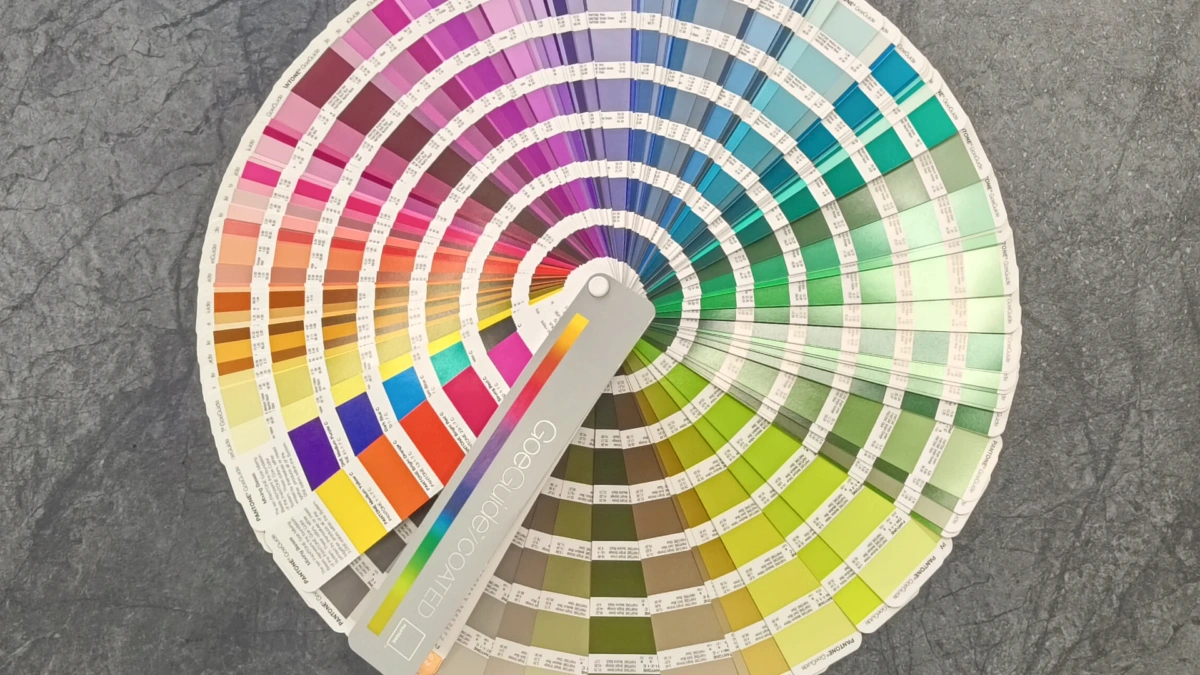
On the left, colors outside of the CMYK gamut, on the right, colors that can simulated in CMYK
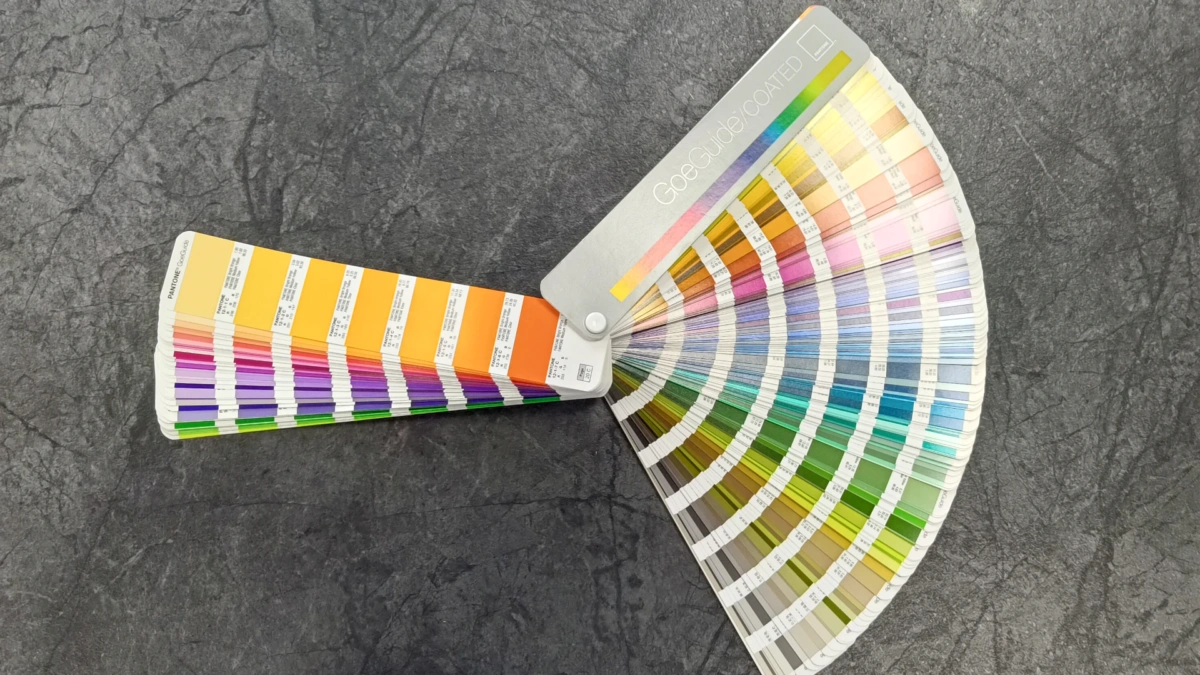
Another perspective, demonstrating the relative small amount of colors potentially benefit from EXG simulation
The Paradox: Precisely Simulating the Undefined?
Another aspect, reality few talk about: color is a moving target.
Customers often request a spot color to be simulated within a delta E2000 of 1.5. But what is the reference?
If you provide a defined CIELab value (D50/2°), we can absolutely predict how accurately it can be simulated—or if simulation is even viable. However, most customers refer to a color name in a physical swatch book. And that’s where the problem starts.
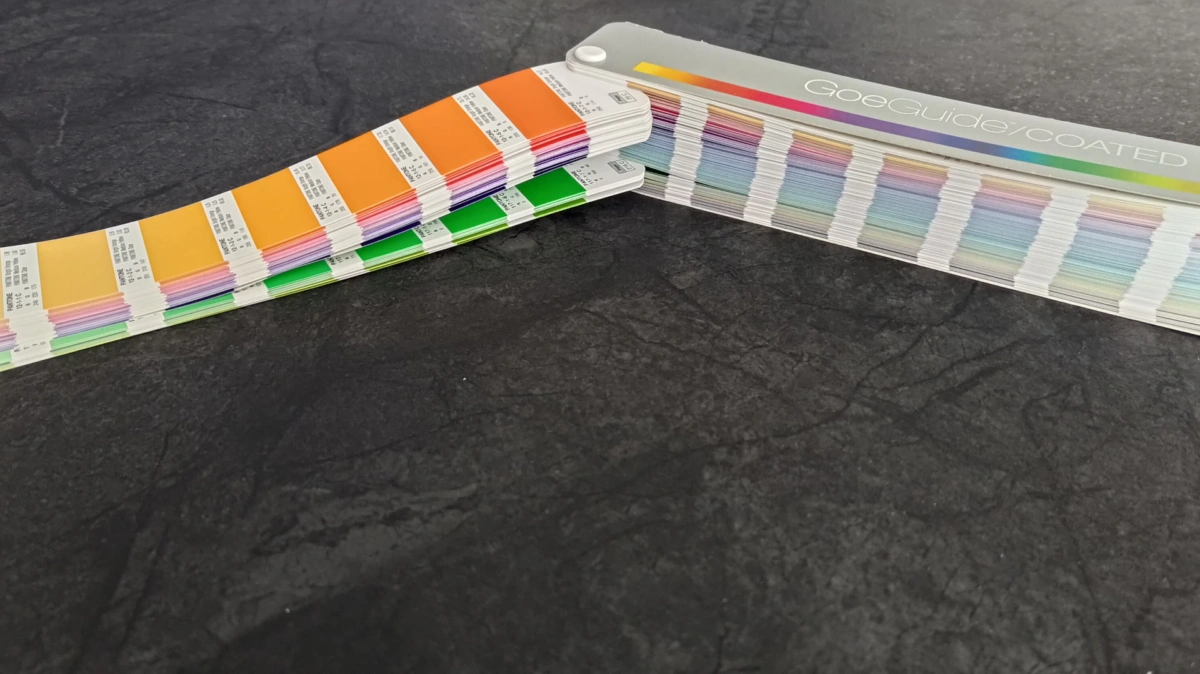
Color books are not permanent standards. They fade, they vary from book to book—even within the same batch. We’ve seen 5-point delta E differences between two color books from the same brand, not to mention between a 10-year-old copy and a brand new one. So which one is the “correct” reference for simulation?
Even the manufacturers of these color books clearly state: they are primarily design tools, not reproduction standards.
To ensure we’re targeting the actual color a customer expects, we need a more precise and objective reference. That means measuring a representative sample from the customer and switching to a colorimetric or spectral-based communication. Anything less invites guesswork, disappointment, and production waste.
Is EXG Right for You?
EXG is a powerful technology, but not for everyone.
It makes the most sense for print service providers who have:
- Carefully analyzed their job mix
- Identified a business case for expanded gamut
- Committed to maintaining consistent workflows
- Built internal capacity to manage and sustain the process
Did any of the risks or limitations outlined above trigger doubts, it may be wise to stick with a traditional spot color workflow for now—and revisit EXG when the time, tools, and team are ready.
If, after careful consideration of the risks associated with EXG, you decide to hold off for now, don’t worry. There are options to help you excel and distinguish yourself in CMYK and traditional spot color applications. RIlink and RImaster are Reprointelligence’s state-of-the-art, AI-enhanced tools that offer 20% better image rendition on paper, save 10-30% on ink, and enhance printing stability without requiring you to leave your CMYK comfort zone. If you choose to adopt EXG later, RI-XPG provides the perfect extension, adding Orange, Green, and/or Violet to your already exceptional printing results.
Ready to Start Your Expanded Gamut Journey? We’ve Got You Covered.
If you’ve come to the conclusion that expanded gamut printing is the right direction for your business, Reprointelligence is here to support you at every step.
With many years of hands-on experience in industrial print production and color management, we guide you safely through the maze of EXG-related decisions: from data preparation and simulation feasibility, to print process control and team training.
Our tools and services are fully scalable—up or down—so you can grow at your own pace. There’s no need for heavy up-front investments or vendor lock-ins. You stay in control, free to choose the best-fit tools for each project.
Reprointelligence’s Product & Service Portfolio for EXG Success
Whether you’re evaluating spot color simulation or preparing for full EXG integration, our tool suite empowers predictable, professional, and independent production workflows:
RI-XPG
Expanded Color Composition Determination
Compatible with any design or publishing software. Enables precise, user-controlled simulation prediction, color channel minimization, and reproducible EXG workflows—before production begins.
RImaster
AI-Optimized Color Management Server
Next-generation PDF and image color conversion, improving perceptual rendering while reducing ink usage by 15–40%. Precision meets eco-efficiency—ideal for high-end CMYK and EXG workflows.
RIlink
Advanced DeviceLink Technology
High-precision ink-saving and color transformation engine for any CMYK-based print process. Unlocks consistent, lossless conversions across devices and presses.
Globalstandard Plus Color Management Server
Optimized for seamless integration with enhanced print production environments (e.g., System Brunner workflows). Delivers superior ink-saving and unrivaled print stability in EXG and CMYK workflows alike.
SB EXG-Tool
A free, labeled version of RI-XPG with essential EXG functionality—perfect for early adopters or evaluation purposes.
EXG is complex—but you don’t have to navigate it alone.
Let Reprointelligence help you unlock its full potential—safely, flexibly, and profitably.